
Broken Bone Theory
A psychological concept suggesting that people who have
never experienced physical injury may instead carry deeper,
unseen emotional or mental struggles.
Imagine going through life without a single visible scar – no cracked bone, no cast, no limp – while others around you collect battle scars from scrapes and fractures.
To some, this seems like pure luck or divine protection. But the Broken Bone Theory suggests a deeper, symbolic story: if your body never “breaks,” perhaps your mind and spirit do instead.
In other words, the very fact that you’ve been spared physical injury might mean you carry an unseen burden of emotional pain. This idea isn’t a medical fact but a poetic way of talking about invisible suffering. It resonates because many people know the ache of silent struggles – feelings that outsiders can’t see or touch.
People who have never broken a bone may still carry deep, invisible pain. The Broken Bone Theory posits that those who avoid physical injury might face greater emotional or spiritual trials.
It’s an idea born on TikTok and social media, where users wonder if there’s meaning in being “unbroken.” The theory itself is not scientifically proven – it’s more of a philosophical or spiritual belief – but it strikes a chord. It gives us a new way to look at pain and resilience.
The Myth of Being UnTouched
Imagine a child who grows up without a single fractured wrist or scraped knee serious enough to leave a mark, while everyone around them collects stories of childhood accidents and unlucky falls.
On the surface, this can look like protection, even a blessing. Some spiritual interpretations of the theory go further, suggesting these people are watched over, held beneath an invisible shield.
But there is another side to that story.
When the body does not carry the pain, the soul sometimes does. It can feel as though life balances itself in unseen ways. Those spared physical injury may still face quieter battles, in terms of emotional weight, mental strain, restless nights, or a sadness they have learned not to show. Their pain does not announce itself. It lives in silence.
The Invisible Fractures
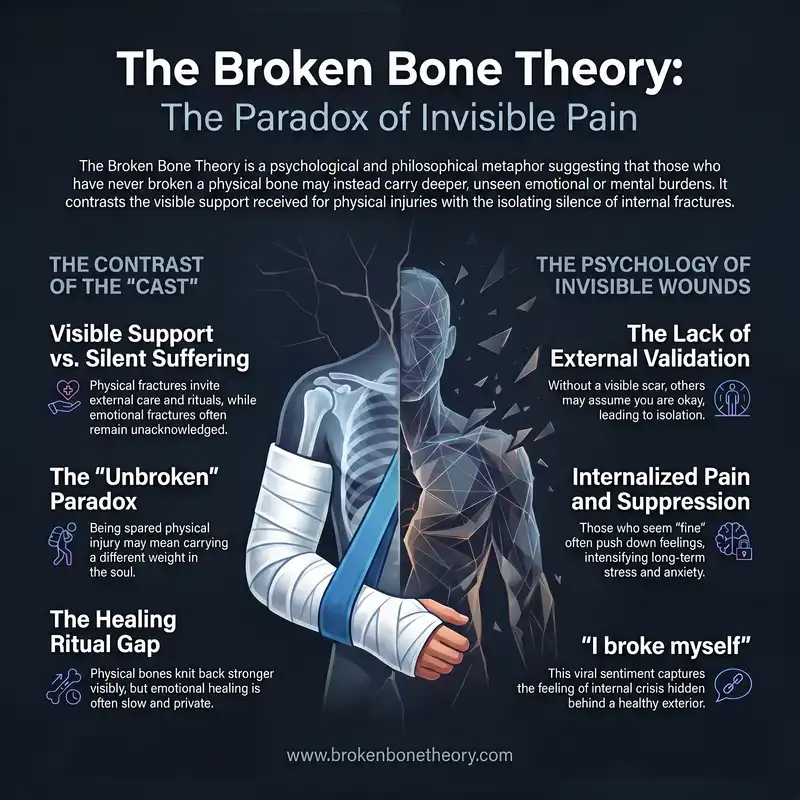
When a bone breaks, the wound is clear. People notice. They ask questions. They offer care. There is a cast, a recovery period, and a visible reminder that healing is happening.
But emotional fractures do not come with obvious signs.
There is no cast for heartbreak, no sling for anxiety, no bandage for a spirit that feels worn thin. People who have never broken a bone may still know what it means to carry pain alone, to smile when they are hurting, and to hold themselves together in ways nobody else sees. That is what makes the theory so haunting. It gives language to a kind of suffering that is usually hidden.
Does Breaking Help Us Heal?
There is something deeply human about the way physical pain is understood. A broken bone heals in stages. It hurts, it mends, and often it becomes stronger where it once fractured. The healing is visible. It can be witnessed.
Emotional pain is different. It often heals slowly, quietly, and without recognition. No one sees the exact moment a person begins to feel lighter again. No one notices every small repair happening beneath the surface.
Maybe that is why this theory resonates. It is not about wanting injury. It is about recognizing that pain, whether visible or hidden, deserves to be seen, acknowledged, and cared for.
What Broken Bone Theory Means
At its core, the Broken Bone Theory uses a metaphor: physical bones represent visible pain, while the “broken” mind or soul represents invisible pain. Literally, the theory says if someone has never actually broken a bone, life has “let go” of that part of them.
Psychologically, some interpret this to mean that fate or the universe expects those people to carry a different kind of wound. In simple terms, the theory contrasts “visible pain” vs. “invisible pain.”
When you break a bone, everyone sees the cast and knows you’re hurting. Other people will ask about your injury and offer help. But emotional wounds – like anxiety, grief, or chronic stress – have no cast. They live inside, often in silence.
The theory suggests a trade-off: maybe you never cracked a bone, but in return you may face a quiet struggle inside. This idea resonates because many of us carry secrets of pain.
If your life story has no chapters about broken arms or shattered legs, perhaps it has chapters marked by quiet hardship: sleepless nights, hidden tears, or a persistent ache in your heart.
Although the theory isn’t proven but sparks conversation. It’s a symbolic way people talk about feeling luckier in one area of life but more challenged in another.
Although the world is full of suffering, it is also full of the overcoming of it.
Helen Keller
Is Broken Bone Theory Real?
Why The Theory Became Popular?
In the age of TikTok and Instagram reels, ideas can catch fire overnight. The Broken Bone Theory took off in part because it’s relatable and shareable.
Many young people talk about deep feelings in short clips, and this theory is easy to explain in a 15-second video: show a neat cast, say “never had one,” then end with “but feeling broken inside.” It makes for a compelling narrative.
Social media thrives on personal stories and questions like “what if?” The question “Why have I never broken a bone?” is a bit unusual – most people just shrug and say “lucky.” But framing it as a mysterious sign of emotional challenge turns it into a puzzle.
TikTok users love reflecting on their life story in catchy ways, and “Broken Bone Theory” fits that style.
In short, the theory went viral for the same reason many ideas do: it taps into a common feeling (quiet suffering) and packages it in a catchy way for social media. It sparks comments, likes, and discussion. And once everyone’s talking about their “unbroken streak,” it feels more true – a kind of group validation.
The Psychology of Silent Struggles
Let’s see why someone might feel that not having visible injuries makes their inner pain harder. Psychology gives us some insight into silent suffering:
Think of someone, who always smiles at work but goes home feeling empty. They never call in sick because there’s nothing physically wrong. If we only judged health by broken bones or fevers, we’d miss their internal crisis.
Psychology reminds us that internal pain can be just as intense. The theory resonates because it calls out this invisibility. It gives language to the experience of being hurt on the inside with no outward sign.
Why People Deeply Connect With This Idea?
For many, the Broken Bone Theory captures a truth: Life can balance the scales in unexpected ways. If one area is smooth, another might be turbulent. Here are some relatable examples:
In each case, people who relate to the theory say: “It’s not about wanting to be hurt; it’s about feeling that my biggest struggles are hidden.” One TikTok user put it plainly: “I’ve never broken a bone but I broke myself.” These stories sound dramatic, but they’re real feelings.
A Reflection for the Unbroken
Final Thoughts
The Broken Bone Theory reminds us of a simple truth: pain is part of being human, even when it leaves no visible trace. It shapes us quietly. It teaches us slowly. And sometimes, it transforms us in ways we do not fully understand until much later.
“Sometimes, the most beautiful healing comes from the fractures we never thought we’d survive.” (And you will.)