Is the Broken Bone Theory Real?
Evidence
Is the broken bone theory real? The short answer is no. The longer answer is more useful, because there are four good reasons the pattern looks real to people.

Key points
- No study has ever tested or supported the broken bone theory.
- Doctors asked about it have all given the same answer. It has no medical basis.
- Four ordinary explanations account for the pattern people notice.
- The claim cannot be proved wrong, which is a serious weakness.
- The feeling behind it is still real, and worth taking seriously.
Is the Broken Bone Theory Real? The Short Answer
No. The broken bone theory is not real.
No researcher has tested it. No paper supports it. It did not come from a laboratory or a clinic. It came from short videos posted on social media in late 2024, and it spread because it felt true to a lot of people.
That does not make the people who share it foolish. It makes them human. But if you came here asking whether science backs this up, the answer is a clean no. A physician who reviewed the trend for VICE reached the same conclusion: no scientific data supports it.
If you found this idea because you are hurting right now, that part matters more than the debate. Call or text 988 in the United States for the Suicide and Crisis Lifeline. Our mental health resources page lists more free services.
The Word “Theory” Is Doing a Lot of Work Here
In science, a theory is not a guess. It is an explanation that researchers have tested many times, over many years, against evidence that could have proved it wrong. Evolution is a theory. Plate tectonics is a theory.
Online, the word often means something closer to “an idea somebody had.” That is what the broken bone theory is. Calling it a theory gives it a weight it has not earned.
This matters because the name changes how people read it. “The broken bone theory” sounds like something a scientist proposed. It was not.
Four Reasons the Pattern Looks Real
Here is the part worth your time. Plenty of people do notice something. They have never broken a bone, and life has been hard. That observation is genuine. The explanation just is not mystical.
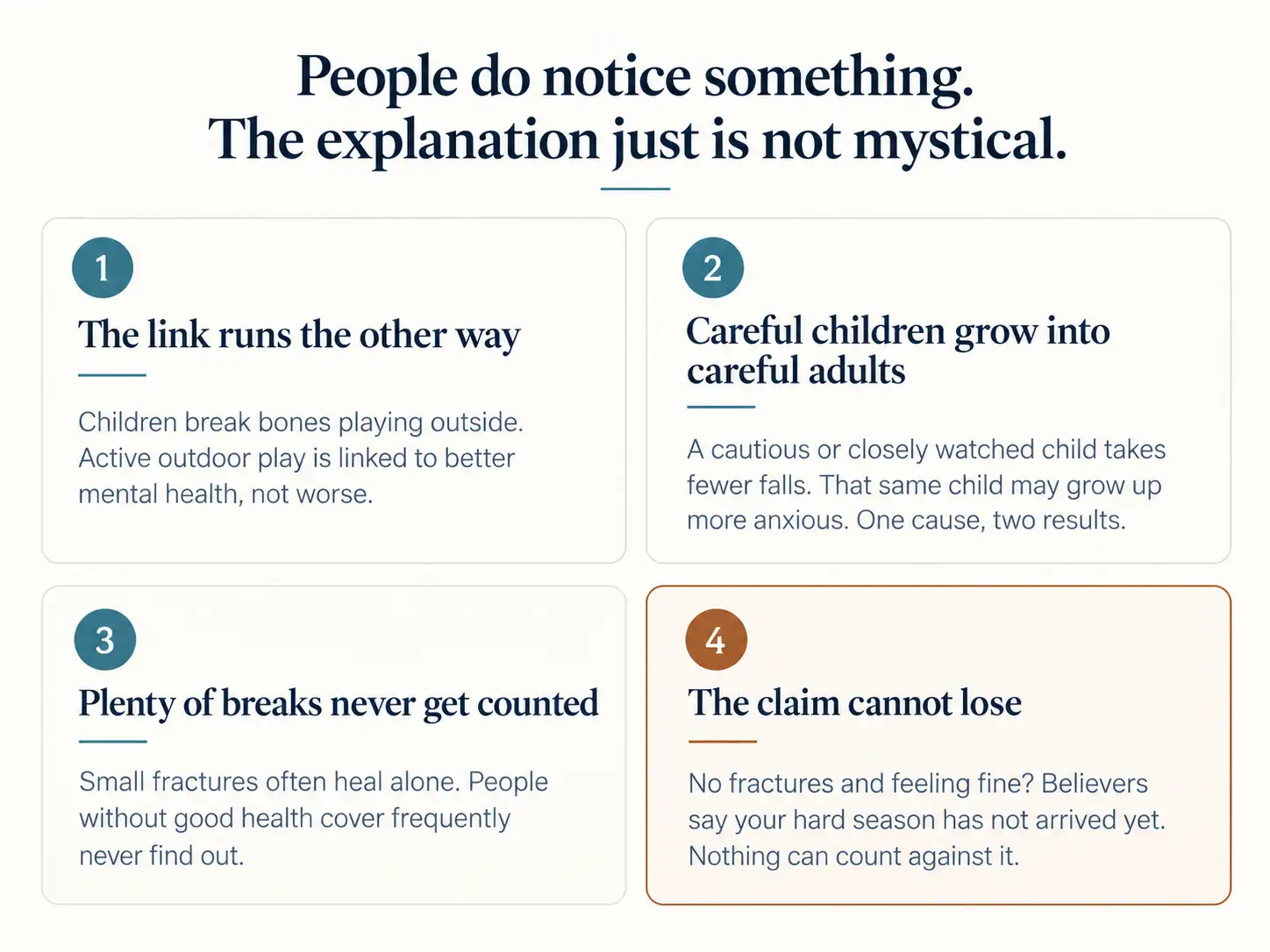
1. The link may run the other way
This is the strongest argument against the theory, and almost nobody makes it.
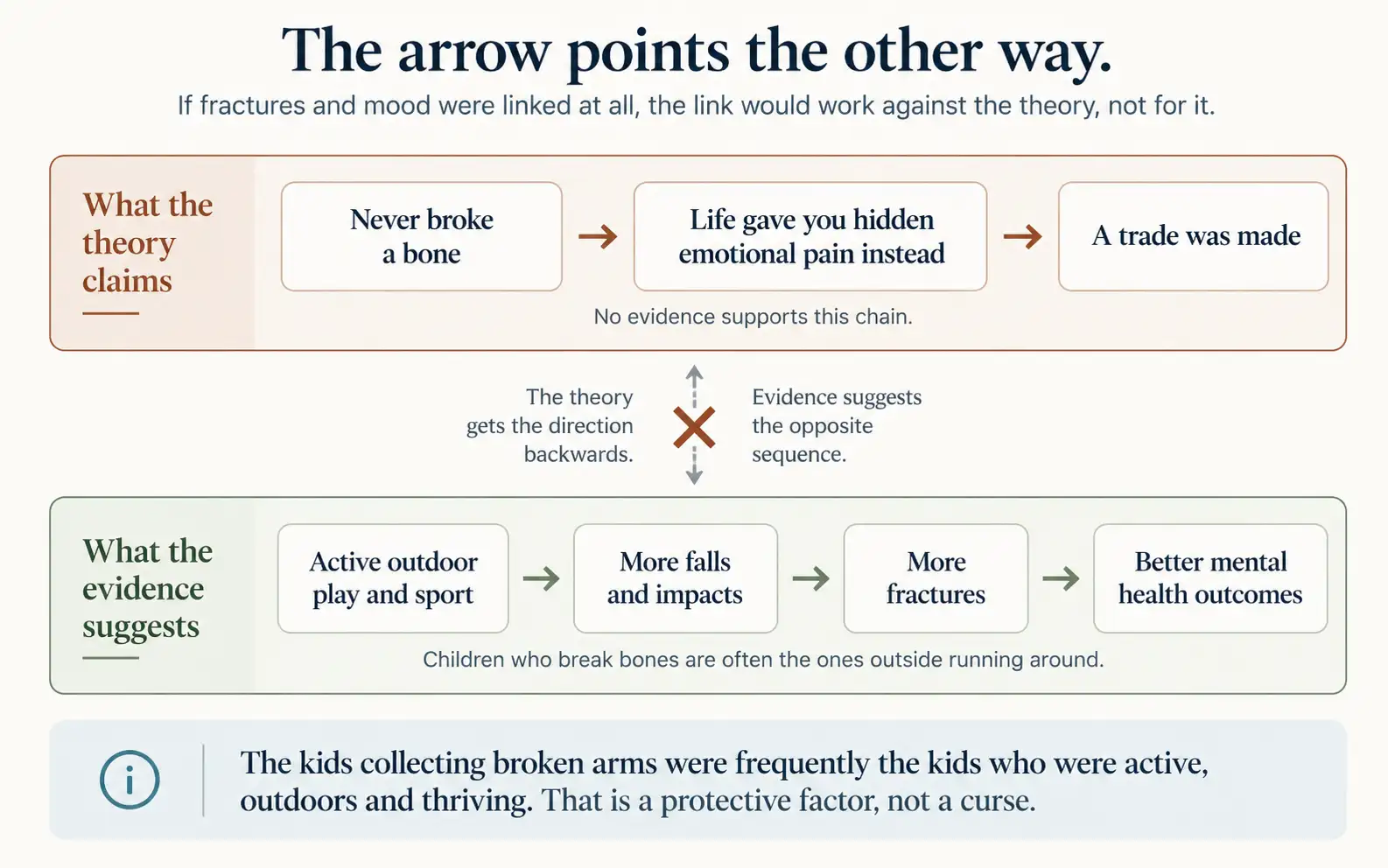
Think about when children break bones. They break them falling off bikes, climbing trees, and playing sport. Active outdoor play is linked to better mental health in children, not worse.
So if fractures and mood were connected at all, the arrow would point the opposite way from what the theory claims. The kids collecting broken arms were often the kids outside running around. That is a protective factor, not a curse.
2. Careful children grow into careful adults
Some people avoid fractures because they avoid risk.
A child who is cautious, or very sensitive to pain, or closely supervised, takes fewer falls. That same child may also grow up more anxious. One underlying trait produces both results.
In my clinic I see this pattern often. People who describe themselves as always careful, always watching, always bracing for something. They rarely got hurt. They also rarely relaxed. Nothing supernatural is required to explain that.
3. Plenty of breaks never get counted
“I have never broken a bone” sometimes means “nobody ever took an X-ray.” Small fractures often heal on their own, and people without good health cover frequently wait them out rather than pay for imaging.
This one undercuts the whole premise, because the theory needs a clean yes or no and real bodies do not give one. We go through it properly on what counts as a broken bone.
4. The claim cannot lose
Ask a believer about someone with no fractures and a happy life, and the usual reply is that their hard season has not arrived yet.
That answer protects the claim from every possible result. No outcome can count against it. In science, an idea that nothing could disprove is not considered strong. It is considered untestable.
A useful idea has to be able to fail. If a claim absorbs every outcome, including the ones that should contradict it, the claim is not explaining anything. It is just restating itself.
What Doctors Actually Say
Reporters have asked physicians about this trend more than once. The answers have been consistent.
Bones break when force beats their strength. How much force that takes depends on bone mineral density, bone shape, age, diet, vitamin D, and certain medicines. None of those things respond to your emotional life.
One point doctors raise is worth knowing. Your skeleton takes tiny cracks all the time and repairs them. That constant remodeling is part of what keeps bone strong. In healthy young people, a full fracture usually needs real force. If nothing has applied that force to you, nothing broke.
We cover the full medical picture on why some people never break a bone.
Does Stress Affect Bone at All?
This is where the theory gets an interesting twist, and it does not go the way believers hope.
Some research links long-term stress, poor sleep, low body weight, and certain psychiatric medicines to lower bone density. If that connection holds, it would mean people under heavy emotional strain break more bones, not fewer.
So the one real link between the mind and the skeleton points against the theory rather than for it.
I want to be careful here. This is an association seen in populations, not a rule about you. Do not read it as a prediction about your own bones. If you take medication and have questions about bone health, raise it with your prescriber.
The Cases That Break It
A claim should fail somewhere. This one fails in both directions, constantly. These patterns come up again and again in public discussions of the trend.
| The theory predicts | What people actually report |
|---|---|
| No fractures means hidden suffering | Adults past 50 with no fractures and no history of mental health problems |
| Fractures mean the pain was physical, so the mind is spared | Athletes with a dozen breaks who also live with depression and anxiety |
| Unbroken bones suggest protection | People with no fractures who have survived cancer, assault, or abuse |
| Risk takers break bones | People who ride motorcycles, skydive and play roller derby with no fractures at all |
Both boxes the theory says should be empty are full, and they are not rare cases. They are common.
What the Theory Gets Right
Here is the part I do not want to throw away.
Visible injuries get care. Break your arm and people notice. They ask questions. They carry your bag. They sign your cast.
Anxiety, grief and depression come with none of that. There is no cast for a hard year. Nobody brings soup for a panic attack they never saw.
That gap is real, and it is worth naming. The broken bone theory names it. The explanation it offers is wrong, but the observation underneath is sound. Hidden pain is easy for everyone to miss, including the person carrying it.
For why that recognition hits so hard, read the psychology behind the broken bone theory.
One Thing to Be Careful About
The theory often arrives with a comforting wrapper. You were chosen. Your suffering made you deeper. Your pain has a purpose.
Please hold that loosely. Pain is not a gift, and you do not need to have earned your struggles for them to count. We cover this in full on why we should stop romanticizing pain.
Questions People Ask
Is the broken bone theory scientifically proven?
No. No published study has tested or supported it. It came from short videos on social media in late 2024, not from research.
Why does it feel accurate to so many people?
The claim is broad enough to fit almost any adult. Nearly everyone carries pain others cannot see, so a statement about hidden suffering reads as personal even though it applies to nearly everybody.
Do doctors believe the broken bone theory?
No. Physicians asked about the trend have consistently said it has no medical basis. They point to bone density, genetics, activity level and force.
Is there any link between stress and bone health?
Some research links long-term stress, poor sleep and certain psychiatric medicines to lower bone density. That points the opposite way from the theory, because it would mean more fractures among people under strain, not fewer.
Can the broken bone theory be proved wrong?
Not as people usually state it. If someone has no fractures and feels fine, believers say their hard season has not come yet. A claim that no outcome can contradict is not testable.
Sources and Further Reading
- National Institute of Arthritis and Musculoskeletal and Skin Diseases (NIAMS). Bone health. niams.nih.gov
- VICE. A doctor gave us their take on the viral “never broke a bone” theory. vice.com
- WellnessPulse. What is the “never broken a bone” theory? wellnesspulse.com
- LADbible. Doctor answers strange theory about people who have never broken a bone. Published October 11, 2025.
Sources last checked September 27, 2026.