Why Have I Never Broken a Bone?
Evidence
The medical answer to the question the broken bone theory answers mystically. It turns out to be more interesting than the myth.

Key points
- A bone breaks when force beats its strength. That is the whole rule.
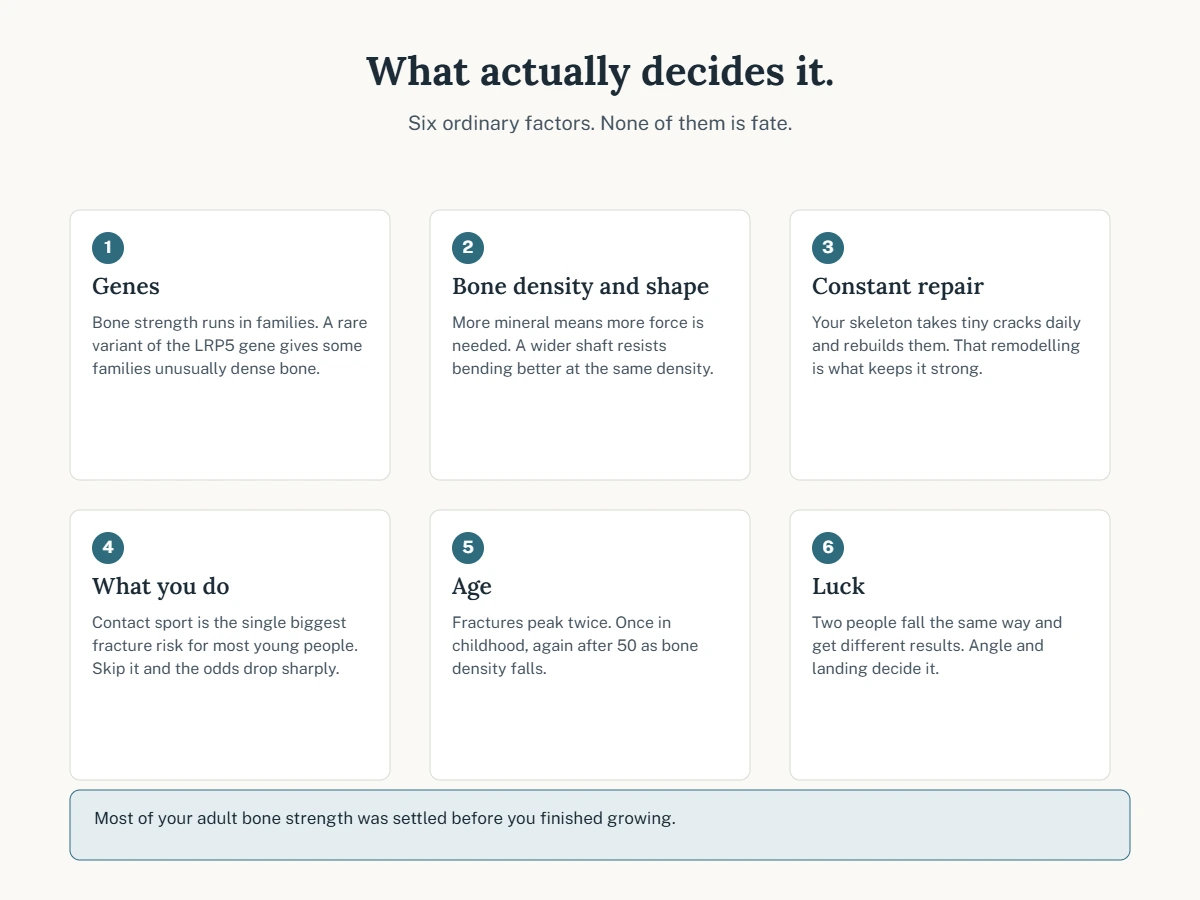
- Genes set much of your bone strength before you get any say in it.
- A rare variant of the LRP5 gene gives some families unusually dense bone.
- Contact sport is the single biggest fracture risk for most young people.
- Your skeleton repairs tiny cracks every day. That is why it stays strong.
Why Have I Never Broken a Bone? Start With One Rule
A bone breaks when the force applied to it beats the strength of the bone.
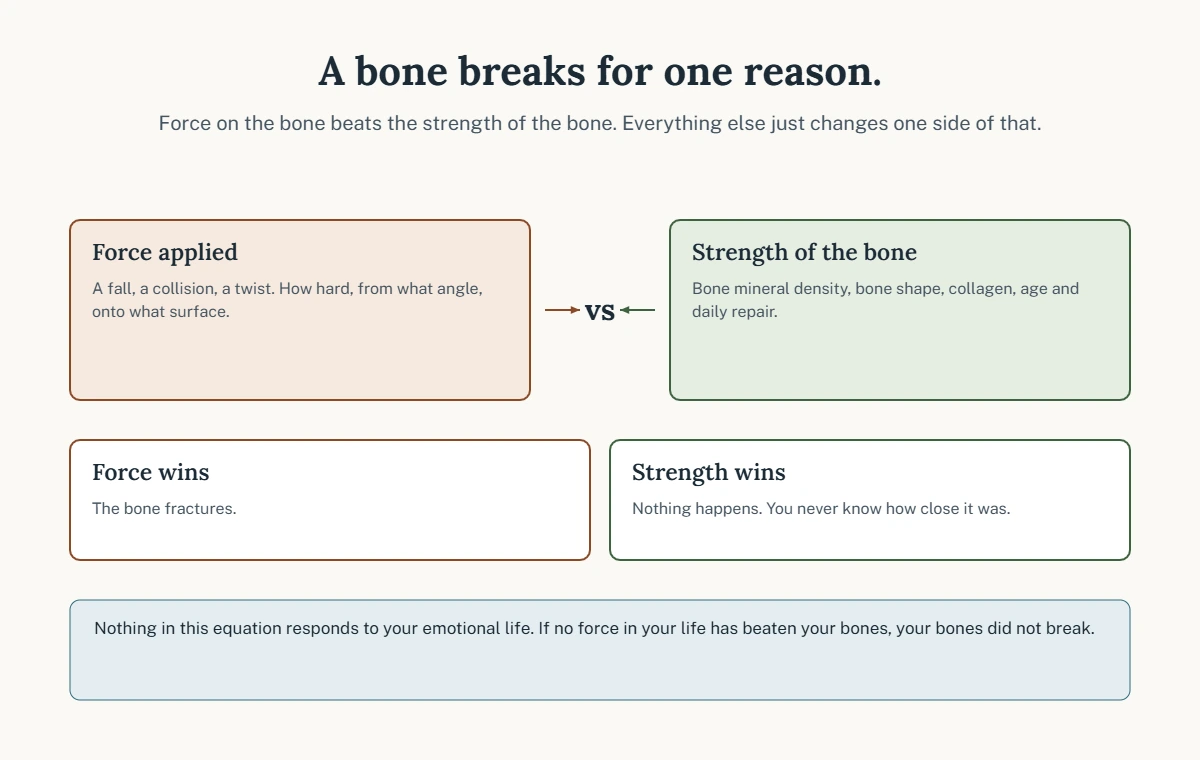
That is it. Everything below is just a list of things that change one side of that equation. If nothing in your life has applied enough force to beat your bones, your bones did not break. No further explanation is needed.
People find this unsatisfying, which is exactly why the broken bone theory caught on. A mystical answer feels bigger than “nothing hit you hard enough.” But the real answer has more going on in it than most people expect.
Bone Density and Bone Shape
Bone mineral density measures how much mineral is packed into your bone. More mineral means more force is needed to crack it.
Density is not the only thing that matters. Bone shape counts too. A wider bone shaft resists bending better than a narrow one, even at the same density. Engineers know this. So do your femurs.
You build most of your bone during childhood and your teens. Peak bone mass usually arrives by around age 30. After that you maintain it rather than add to it, and from around 50 it starts to decline.
Most of your adult bone strength was decided by the time you finished growing. Habits in childhood and early adulthood matter more than anything you do at 45.
Your Genes Did Most of the Work
Bone strength runs in families. Studies of twins and relatives suggest genetics accounts for a large share of the differences between people.
The clearest example is a gene called LRP5. It plays a role in building bone. Certain rare variants of it cause what doctors call high bone mass. People who carry those variants have notably dense, strong skeletons, and fractures are uncommon for them.
These variants are unusual, so this is not the explanation for most people. But it is a real, documented reason some families simply do not break bones, and it has nothing to do with protection or fate.
Other inherited factors matter too, including how your body makes collagen. Collagen gives bone a bit of flex. Without it, bone becomes brittle, which is what happens in conditions such as osteogenesis imperfecta.
Your Bones Rebuild Themselves Constantly
This is the part most people have never heard, and it is the most interesting thing in the article.
Your skeleton is not a fixed structure. It is being taken apart and rebuilt all the time. Cells called osteoclasts remove old bone. Cells called osteoblasts lay down new bone. The process runs continuously, throughout your life.
Along the way, your bones take tiny cracks from ordinary use. Walking. Running. Carrying shopping. Those micro cracks get repaired as part of the same cycle, usually before you ever know they happened.
So in a small sense, your bones have been breaking and healing your whole life. The reason you have never noticed is that the repair kept up.
What You Do With Your Body
For most young people, this is the biggest factor of all.
Fractures in healthy young adults usually need real force. A serious fall, a car accident, or a hard collision. The activities that supply that force are fairly predictable.
| Higher fracture exposure | Lower fracture exposure |
|---|---|
| Contact sport such as football, rugby, hockey | Swimming, cycling on paths, gym work |
| Skateboarding, BMX, motocross | Walking, running on even ground |
| Gymnastics, climbing, martial arts | Yoga, pilates, rowing |
| Manual trades, roofing, scaffolding | Desk based work |
One doctor’s blunt version of this is worth repeating. When someone says they have never broken a bone, it often just means they never played a contact sport at a competitive level.
Age Changes the Picture Twice
Fractures are not spread evenly across a lifetime. They cluster at two points.
Childhood. Children fall constantly, and their growing bones have soft areas called growth plates that are more vulnerable. Most childhood fractures come from ordinary play.
After 50. Bone density declines with age, faster after menopause. Fractures that would not have happened at 25 start happening from standing height falls.
If you are in the middle of that range and have not broken anything, you are in the quietest stretch of the curve.
Other Things That Change Your Odds
- Vitamin D and calcium. Both are needed to build and maintain bone. Long-term shortfalls weaken it.
- Smoking. Linked to lower bone density and slower healing.
- Heavy alcohol use. Affects bone building and raises fall risk at the same time.
- Some medicines. Long-term steroids are the best known. Some psychiatric medicines have also been linked to lower bone density in research.
- Body weight and hormones. Very low body weight and hormone changes both affect bone maintenance.
- Access to care. Not every fracture gets diagnosed, so some people have broken a bone without ever knowing. See what counts as a broken bone.
That point about medicines matters to some of my patients, and I want to handle it honestly. Some research links certain psychiatric medicines to lower bone density. That is an association across populations, not a prediction about you, and it is not a reason to stop a medicine that is helping you. Raise it with your prescriber instead. Stopping psychiatric medication without support carries its own real risks.
And Then There Is Luck
Two people can fall the same way and get different results. The angle of the landing, what they hit, how they twisted, whether they put a hand out. Small differences decide whether a bone cracks.
This is unsatisfying, and it is true. A fair share of never having broken a bone is simply that the specific unlucky combination never lined up for you.
What It Does Not Mean
Strong bones tell you about your skeleton. They do not tell you about anything else.
They do not mean you are healthy overall. People with dense bone get cancer, heart disease and autoimmune conditions like everyone else. They do not mean you are protected. And there is no evidence that they mean you were handed emotional suffering in exchange.
If you want the full argument on that last point, read is the broken bone theory real. If you want to know what counts as a break in the first place, see what counts as a broken bone.
Questions People Ask
Why have I never broken a bone?
Usually a mix of four things. Bone that is dense and well shaped, a life without high force impacts such as contact sport, an age range where fractures are less common, and luck. Genetics sets much of it before you have any say.
What is the LRP5 gene?
LRP5 is a gene involved in building bone. Certain rare variants cause unusually high bone mass and run in families. People who carry them have dense, strong bone and rarely fracture.
Do strong bones mean I am healthy?
No. Bone strength says something about your skeleton, not about your heart, immune system or mental health. Plenty of people with strong bones live with serious conditions.
Can I make my bones harder to break?
To a degree. Weight bearing exercise, enough calcium and vitamin D, not smoking, and limiting heavy alcohol all help. Most peak bone mass is built by your late twenties, so early habits matter most.
Does never breaking a bone mean something spiritual?
There is no evidence for that. Bone density, activity level, age and luck account for it fully. Some people find personal meaning in it, which is a belief rather than a medical finding.
Sources and Further Reading
- National Institute of Arthritis and Musculoskeletal and Skin Diseases (NIAMS). Bone health and osteoporosis. niams.nih.gov
- NIH Osteoporosis and Related Bone Diseases National Resource Center. Peak bone mass. niams.nih.gov
- Tyla. Doctor reveals what it means if you have never broken a bone. Published February 2025.
- LADbible. Doctor answers strange theory about people who have never broken a bone. Published October 2025.
Sources last checked September 27, 2026.