The Broken Bone Theory Bible Verses, in Context
Meaning
Three broken bone theory Bible verses get quoted for this idea. All three are real. What they say, in context, turns out to be different from what the theory claims.
Key points
- The broken bone theory is not in the Bible. No denomination teaches it.
- Three passages get cited: Psalm 34:20, Exodus 12:46 and John 19:36.
- All three are real and the wording is close to what people quote.
- None of them promises that a believer will never fracture a bone.
- Psalm 34 actually says the righteous person faces many troubles.
We quote the passages, give the surrounding context, and describe how different readers understand them. We are not theologians and we do not tell you what scripture means for your faith. For that, speak to someone in your own tradition.
Psalm 34:19-20
This is the verse people quote most. It is usually quoted alone, which is where the trouble starts.
Many are the afflictions of the righteous, but the Lord delivers him out of them all. He keeps all his bones; not one of them is broken.
Psalm 34:19-20
Notice what verse 19 says before the famous line. The righteous person has many afflictions. The passage does not describe a protected, easy life. It describes a hard life with rescue in it.
That order matters. Trouble comes first in the text. Deliverance comes after. Read together, the two verses say that God brings the faithful through hardship, not around it.
The wording changes between translations
Different Bibles render verse 20 differently, and the difference is not trivial.
| Translation | Psalm 34:20 |
|---|---|
| ESV | He keeps all his bones; not one of them is broken. |
| NIV | he protects all his bones, not one of them will be broken. |
| KJV | He keepeth all his bones: not one of them is broken. |
The NIV reads as a future promise. The ESV and KJV read as a present statement. People arguing about this verse online are often arguing about a translation choice without knowing it.
How Christian tradition reads it
Many Christian commentators read Psalm 34:20 as pointing forward to the crucifixion rather than as a promise about individual bodies. That reading rests on John 19:36, which we come to below.
Exodus 12:46
The second passage is not about people at all. It is an instruction about a meal.
It shall be eaten in one house; you shall not take any of the flesh outside the house, and you shall not break any of its bones.
Exodus 12:46
This sits in the middle of the instructions for Passover. The lamb was to be eaten in one household, and its bones were to be left unbroken. Numbers 9:12 repeats the same rule.
In its own setting, this is ritual law. It describes how a specific meal was to be prepared and eaten. It says nothing about whether any person will break a bone.
John 19:36
The third passage is what connects the other two.
In the account of the crucifixion, soldiers break the legs of the men executed alongside Jesus to hasten death. When they reach Jesus, they find him already dead and do not break his legs. The writer then adds a comment.
For these things took place that the Scripture might be fulfilled: “Not one of his bones will be broken.”
John 19:36
This is the verse that ties the Passover lamb to the crucifixion. It is why Christian tradition reads Exodus 12 and Psalm 34 as pointing forward rather than as general promises.
What the Broken Bone Theory Bible Verses Add Up To
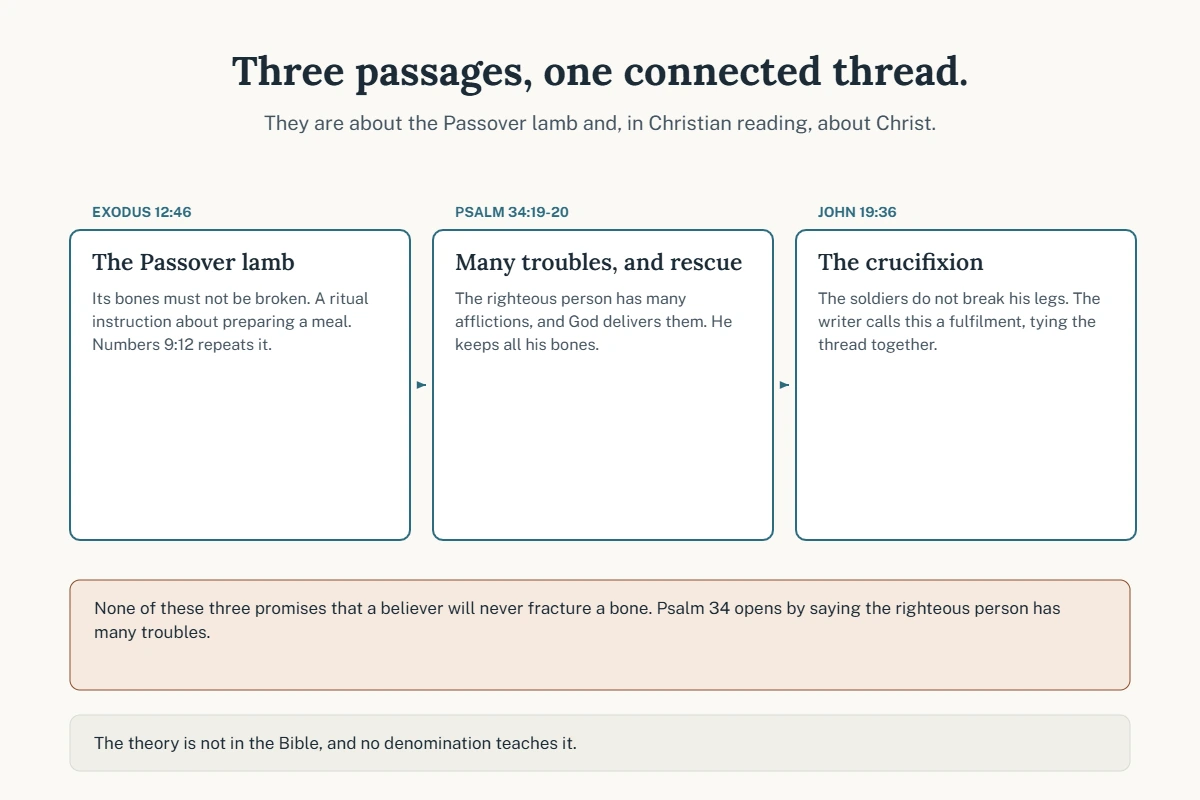
Put together, the standard Christian reading runs like this. The Passover lamb’s bones were kept whole. Psalm 34 speaks of bones kept whole. John says Jesus’ bones were kept whole, and calls that a fulfilment of both.
It is a connected thread about one figure and one event. That is a very different thing from a claim about who does or does not fracture a wrist.
These passages are about the Passover lamb and, in Christian reading, about Christ. They are not a promise of physical protection for individual believers, and they were never presented that way.
What the Trend Does With Them
The broken bone theory takes these verses and turns them into something else. It reads them as evidence that people who have never fractured a bone are under special protection, and that the protection came with a price paid somewhere else.
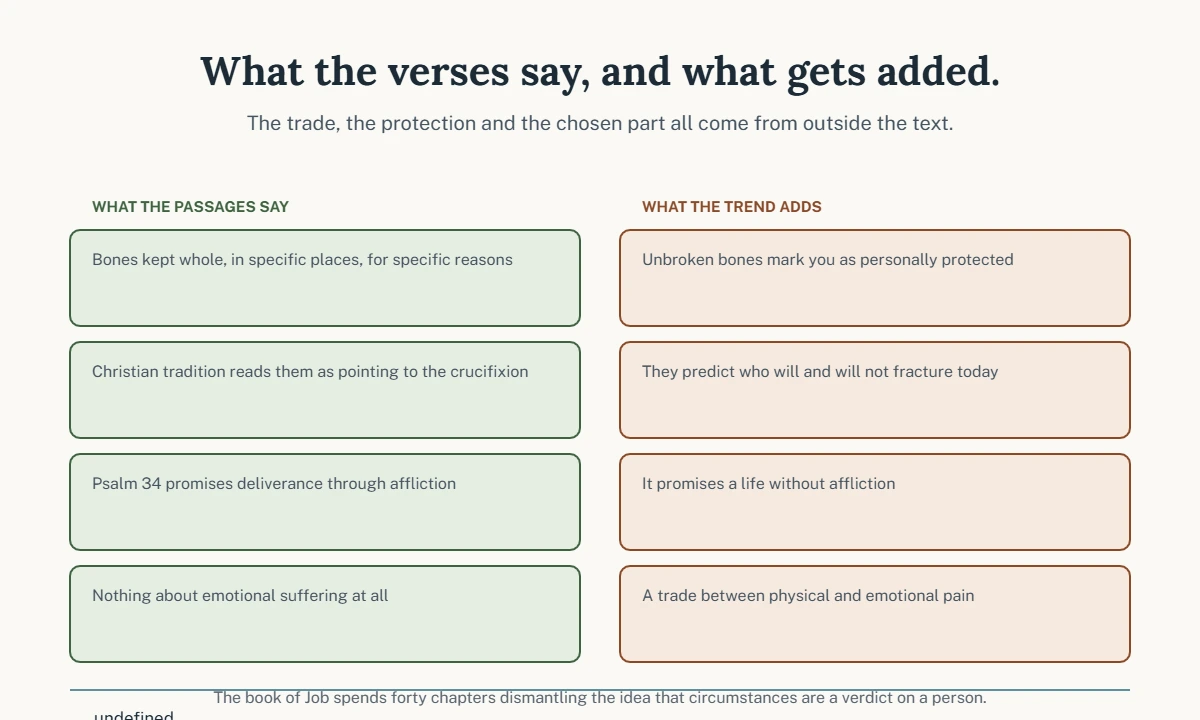
Two problems follow, and they are worth stating plainly.
The verses do not make that claim
None of the three says anything about a trade. None mentions emotional suffering. None promises anything to a reader about their own skeleton. The trade is added from outside.
The reverse claim becomes unkind
If unbroken bones show favour, then broken bones have to mean something too. Follow that and you arrive at the idea that the millions of faithful people who have fractured a bone were passed over.
We could also find no denomination, in any tradition, that teaches this. There is no catechism entry, no confession, no statement of faith that includes it. What exists is people connecting verses they know to something they saw online, which is an old and human thing to do, but it is not doctrine.
What Job Has to Say About It
There is an older answer in scripture to the whole shape of this idea, and it is worth knowing.
The book of Job spends forty chapters on one question. Job suffers terribly. His friends arrive and insist that suffering on that scale must mean he did something to deserve it. They are certain, they are eloquent, and by the end of the book they are told they were wrong.
That is the same reasoning the broken bone theory uses, pointed in the opposite direction. One says pain proves fault. The other says the absence of pain proves favour. Both read a person’s circumstances as a verdict on them.
If this question matters to your faith, take it to your pastor, priest or minister. That conversation will serve you better than any article, including this one.
The Honest Reading
Here is what the passages support, stated carefully.
- Scripture does speak about bones being kept whole, in specific places, for specific reasons.
- Christian tradition reads those places as connected to the Passover and the crucifixion.
- Psalm 34 promises deliverance through affliction, and says clearly that affliction comes.
- No passage promises any individual that they will never break a bone.
- No passage says anything about a trade between physical and emotional pain.
For the wider spiritual readings people give this idea, see the spiritual meaning of never breaking a bone. For why bones actually break, see why some people never break a bone.
Questions People Ask
Is the broken bone theory in the Bible?
No. The theory is not in the Bible and no denomination teaches it. People connect it to three passages that mention unbroken bones, but none of those passages makes the claim the theory makes.
What does Psalm 34:20 mean?
It says God keeps the bones of the righteous person, and not one is broken. Read with verse 19, which says that person has many troubles, it describes rescue through hardship rather than a life without it. Christian tradition also reads it as pointing to the crucifixion.
Why does Exodus say not to break the bones of the Passover lamb?
Exodus 12:46 is a ritual instruction about how the Passover meal was prepared. Numbers 9:12 repeats it. Christian tradition later read it as a picture of Christ.
Does the Bible promise believers will not break bones?
No. None of these passages promises physical protection from fractures. Psalm 34 explicitly says the righteous person faces many troubles. Faithful people break bones like everyone else.
What is John 19:36 about?
It notes that Jesus’ legs were not broken during the crucifixion, unlike those of the men beside him, and says this fulfilled scripture. It points back to the Passover lamb instruction and to Psalm 34.
Sources and Further Reading
- Bible Hub. Psalm 34 in parallel translations. biblehub.com
- Open Bible. Bible verses about broken bones. openbible.info
- Bible Hub. Topical entry: fractures. biblehub.com
Scripture quotations are given with their translation named. Sources last checked September 27, 2026.