Broken Bone Theory Psychology: Why It Feels True
Meaning
The theory is not real. The reaction to it is. Here is what makes a made-up idea land so hard, and what it says about pain nobody can see.

Key points
- Psychology does not recognise the broken bone theory. It is folklore, not a concept.
- Psychology does explain why it spreads, and that part is genuinely interesting.
- The Barnum effect makes a vague claim feel written about you personally.
- Invisible pain gets less care than visible injury, and that gap is real.
- Feeling seen by an idea is good. Stopping there is not.
Call or text 988 in the United States for the Suicide and Crisis Lifeline, or text HOME to 741741. More options sit on our mental health resources page.
First, a Clarification
People search for “broken bone theory psychology” expecting to find a recognised idea. There is not one.
No textbook lists it. No clinician uses it. It is not a diagnosis, a framework, or a school of thought. It is a piece of internet folklore that began on TikTok in late 2024. If you want the evidence side, read is the broken bone theory real.
What psychology can do is explain the reaction. Millions of people read this idea and felt something click. That response is real, and it has causes we understand well.
Broken Bone Theory Psychology: Why a Vague Claim Feels Personal
Read this sentence: you carry pain that other people cannot see.
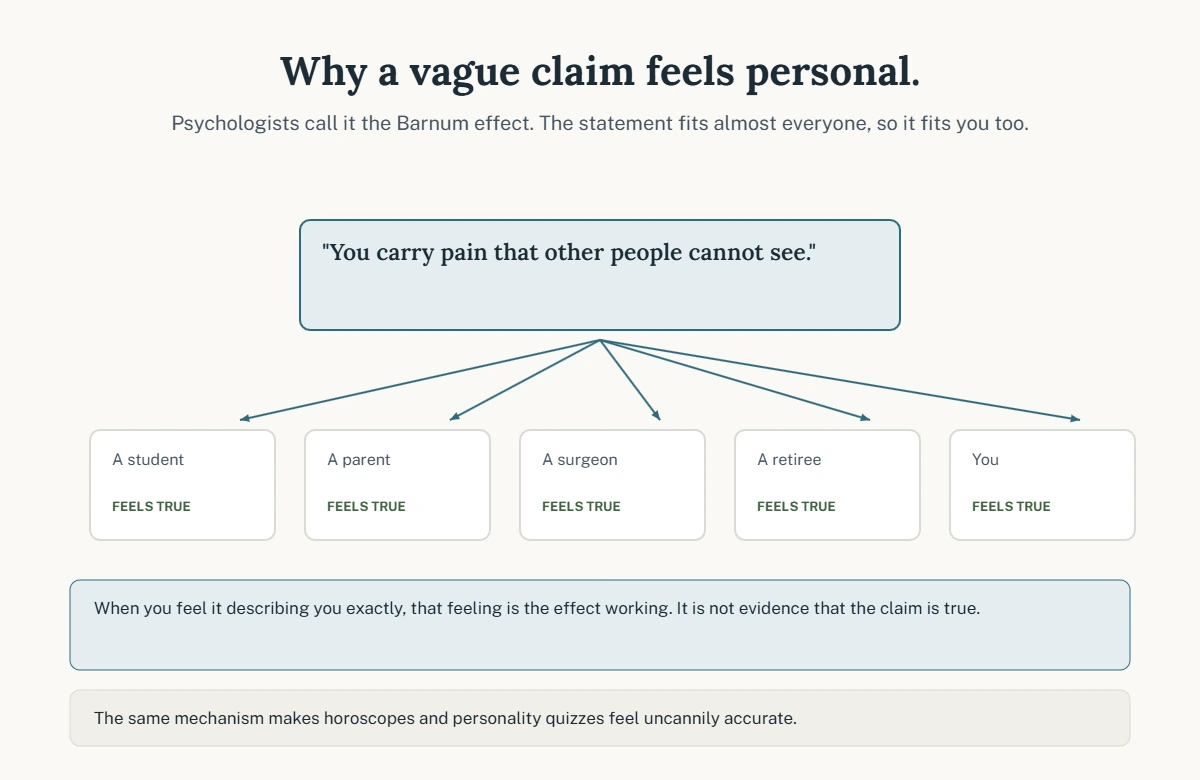
Did it feel true? For most adults it will, because it is true of most adults. That is the trick.
The tendency to read a broad, general description as an exact account of yourself. It is why horoscopes and personality quizzes feel uncannily accurate. The statement fits almost everyone, so it fits you too.
The broken bone theory runs on this. Its core claim applies to nearly every person alive. When you feel it describing you exactly, that feeling is the effect working, not evidence that the claim is true.
Knowing this does not make the recognition worthless. It just explains where it came from.
We Are Built to Find Patterns
Human brains look for connections constantly. This is useful. It is also prone to error.
Psychologists call the habit of seeing meaningful patterns in unrelated things apophenia. You notice you have never broken a bone. You notice life has been hard. Your mind links them, because linking is what it does.
Two true facts sitting next to each other are not the same as one causing the other. But the link feels obvious once it forms, and it is hard to unsee.
The Real Thing Underneath: Invisible Pain
This is the part that deserves respect.
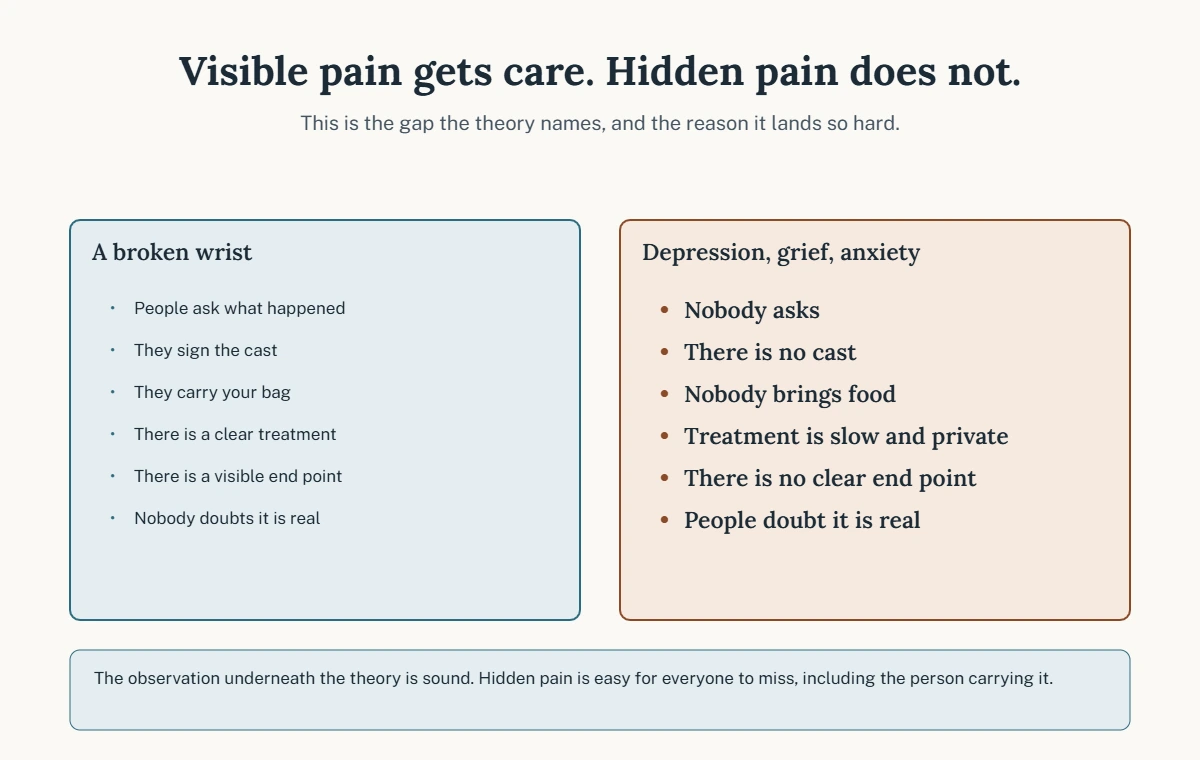
Break your wrist and the world responds. People ask what happened. They sign the cast. They carry your bag. There is a clear story with a start, a treatment and an end.
Now try depression. Or grief. Or anxiety that wakes you at 4am. There is no cast. Nobody brings food. Most people never find out. Even the people who love you may not notice, because you have become very good at hiding it.
In my practice, this is one of the most common things patients say. Not “I am in pain,” but “nobody knows I am in pain.” Those are different problems, and the second one is often heavier.
Suffering with no outward sign is harder to carry than suffering people can see. Not because the pain hurts more, but because you carry it alone, and you often have to keep performing while you do.
Why Some People Hide It So Well
Many people learn early that showing distress does not help. Maybe it upset someone. Maybe nobody responded. Maybe the household simply had no room for it.
So they get good at looking fine. Clinicians sometimes call this masking. It works, in the short term.
Over the long term, pushing feelings down steadily is linked to higher distress, not lower. There is a second cost too. If you never show anyone what is happening, the people who might help you never learn that you need it. The support that could arrive does not, and that confirms the belief that nobody notices.
You can see why a theory that says “your pain is real even though it is invisible” lands hard on someone living in that loop.
The Pull of Meaning
People want their suffering to mean something. That is not weakness. It is one of the most consistent findings in psychology.
Random pain is harder to bear than pain with a reason. So when an idea offers a reason, even a strange one, it brings relief. You were protected. You were chosen. There was a trade.
The relief is genuine. The explanation is still made up. Both of those things can be true at once, and holding both is the honest position here.
What This Looks Like in Relationships
People often bring this idea into conversations about a partner or family.
Usually it goes something like this. He has never broken a bone and he never says what he feels. Or, she thinks I am fine because I always seem fine.
Used one way, the theory helps. It opens a door. It gives someone language for a conversation they did not know how to start.
Used another way, it closes one. If the message you take is that your pain is meant to be invisible, or that carrying it silently is your role, the idea becomes a reason not to speak. That is the version to watch out for.
If you want a starting line, try something small and direct. “There is something I have been carrying and I have not told you about it.” That sentence does more work than any theory.
When Hidden Pain Needs Real Help
Reading an idea and feeling seen is a good moment. It is not treatment. Consider talking to a professional if any of these fit.
- Low mood, worry or numbness most days for two weeks or more
- Sleep or appetite that has changed a lot and stayed changed
- Pulling away from people you normally care about
- Using alcohol or anything else to get through the day
- Feeling that things would be easier if you were not here
That last one needs attention today, not eventually. Call or text 988 in the United States, or use our resources page.
You do not need a crisis to deserve help. Most people wait far longer than they need to, usually because nothing looks wrong from the outside.
The Useful Part
Drop the trade. Drop the idea that something chose this for you. Keep the question underneath.
Who knows what you are carrying?
If the answer is nobody, that is worth changing, and it is changeable. Not because your pain earned you a cosmic exemption, but because carrying it alone makes it heavier than it has to be.
One more thing, and it matters. Read why we should stop romanticizing pain before you accept the comforting version of this idea. Suffering is not a gift, and you do not owe anyone depth in exchange for it.
Questions People Ask
What is the broken bone theory in psychology?
Psychology does not recognise it as a concept. It is internet folklore. Psychology can explain why it spreads, using the Barnum effect, pattern seeking, emotional suppression and the human need to find meaning in hardship.
What is the Barnum effect?
It is the tendency to read a broad, vague description as a precise account of yourself. It explains why horoscopes feel accurate. A claim that you carry pain nobody sees fits almost every adult alive.
Is invisible pain real?
Yes. Anxiety, depression, grief and chronic pain are real conditions with real effects, even when nothing shows on the outside. Pain does not need a visible sign to count or to deserve treatment.
Does hiding your feelings make things worse?
Pushing feelings down as a habit is linked to higher distress over time, and to weaker support, because people never learn anything is wrong. Naming what you feel usually helps more than sealing it away.
How does the broken bone theory affect relationships?
Some people use it to explain why they feel unseen by a partner or family. It can open a useful conversation. It becomes a problem when it is used to justify staying silent instead of asking for what you need.
Sources and Further Reading
- Psychology Today. Invisible pain is no less real. psychologytoday.com
- National Institute of Mental Health. Depression: signs and symptoms. nimh.nih.gov
- 988 Suicide and Crisis Lifeline. 988lifeline.org
Sources last checked September 27, 2026.