Does a Broken Toe Count? What Counts as a Broken Bone
Evidence
Does a broken toe count? What about dislocations, hairline cracks and growth plates? These are the questions people actually ask, and almost nobody answers them properly.

Key points
- A fracture and a break are the same thing. There is no medical difference.
- Toes, fingers, ribs and the nose all count. They are bones.
- Dislocations and sprains do not count. No bone cracked.
- Teeth are not bones, so a chipped tooth does not count.
- Stress fractures, hairline cracks and growth plate injuries all count.
Fracture and Break Mean the Same Thing
This causes more confusion than anything else on the subject, so let us settle it first.
There is no medical difference between them. “Fracture” is the word doctors use. “Break” is the word everyone else uses. If a doctor says you have a fracture, your bone is broken.
People often assume a fracture is milder than a break, or that a break is the serious version. Neither is true. A hairline fracture and a shattered femur are both fractures, and both are breaks. What changes is the type and severity, not the word.
What Counts, and Does a Broken Toe Count?
If it is a bone and it cracked, it counts. Your skeleton has around 206 bones in adulthood, and every one of them qualifies.
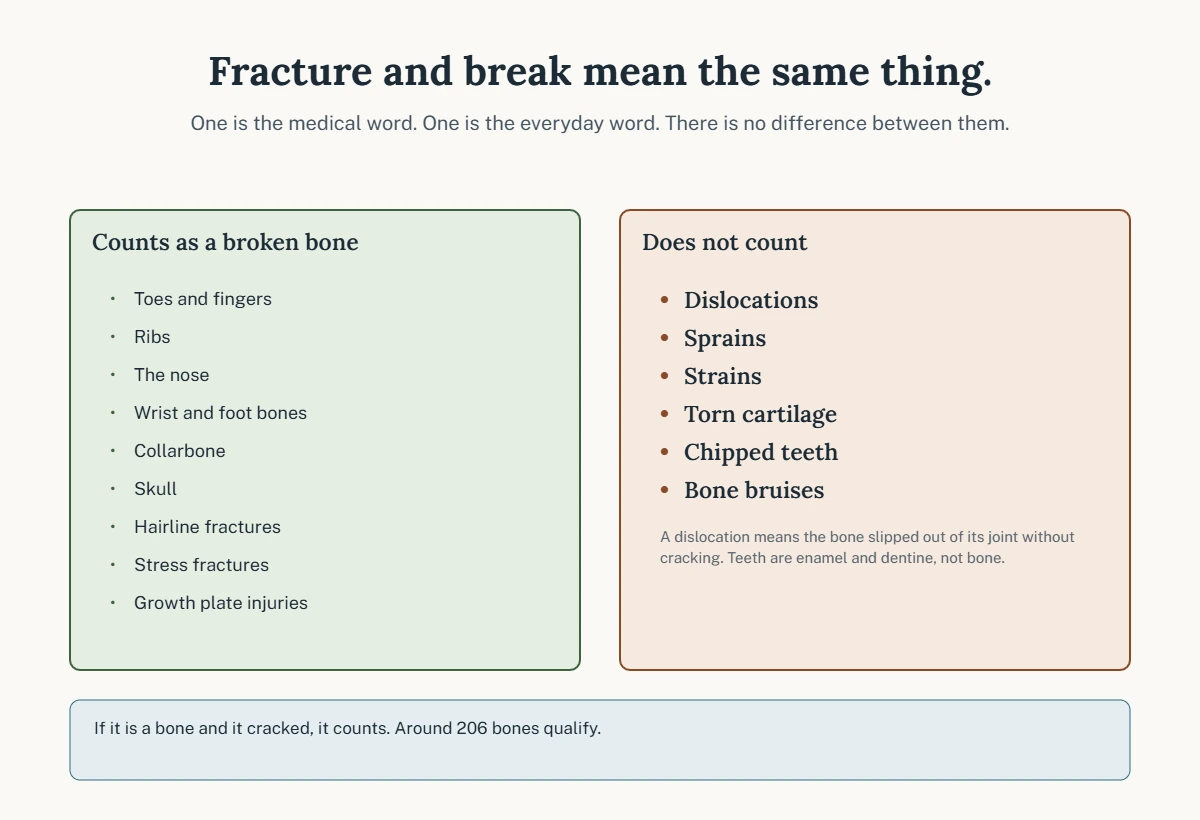
- Toes and fingers. Yes. These are among the most commonly broken bones in the body.
- Ribs. Yes. Often not treated with anything beyond rest, but still fractures.
- The nose. Yes. The nasal bone is a bone. A broken nose is a broken bone.
- Wrist and foot. Yes. These contain many small bones, and the scaphoid in the wrist is notorious for being missed.
- Skull. Yes, obviously, though this is a serious injury rather than an edge case.
- Collarbone. Yes. One of the most commonly broken bones in children.
What Does Not Count
These are injuries, and some of them hurt a great deal. They are not fractures.
| Injury | What actually happened | Is it a break? |
|---|---|---|
| Dislocation | A bone slipped out of its joint. The bone is intact. | No |
| Sprain | A ligament stretched or tore. | No |
| Strain | A muscle or tendon stretched or tore. | No |
| Torn cartilage | Cartilage damaged, often in the knee. | No |
| Chipped tooth | Teeth are not bones. | No |
| Bone bruise | Bleeding and swelling inside the bone, no crack. | No |
A dislocation can happen at the same time as a fracture, and that combination is common at the shoulder and ankle. But a clean dislocation on its own leaves the bone whole.
Why Teeth Are Not Bones
People are often surprised by this one.
Teeth are made mostly of enamel and dentine. They contain no marrow. They do not have the cells that constantly break down and rebuild bone, which is why a chipped tooth never heals and a cracked bone does.
So if you cracked a tooth falling off your bike at ten, you still have not broken a bone.
Types That Catch People Out
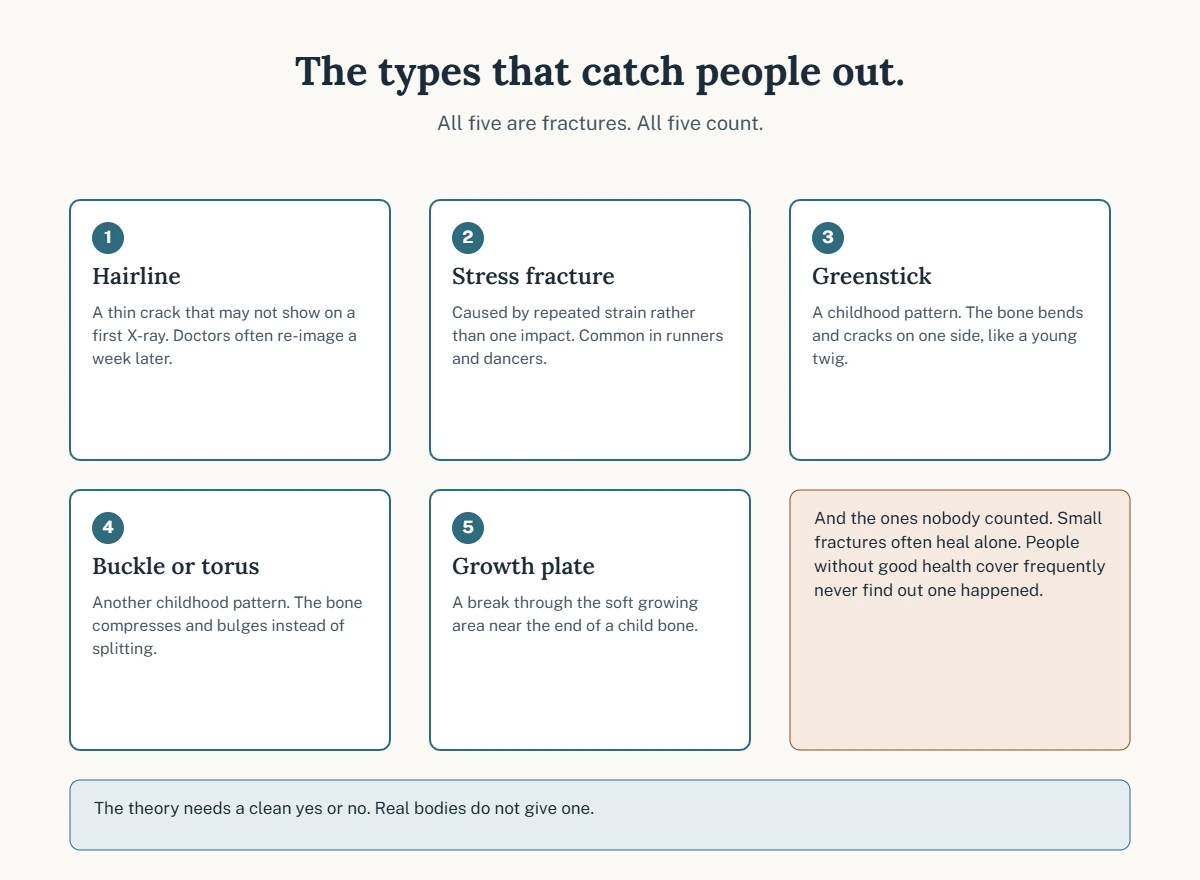
Hairline fracture
A thin crack that may not show on a first X-ray. Still a fracture. Doctors sometimes repeat imaging a week or two later once healing makes the line visible.
Stress fracture
A small crack caused by repeated strain rather than one impact. Common in runners, dancers and military recruits. It counts.
Greenstick fracture
A childhood injury where the bone bends and cracks on one side without breaking all the way through, like a young twig. It counts.
Buckle or torus fracture
Another childhood pattern, where the bone compresses and bulges rather than splitting. It counts.
Growth plate fracture
A break through the soft growing area near the end of a child’s bone. Doctors classify these using the Salter-Harris system. They count, and they need proper care because they can affect how the bone grows.
The Ones Nobody Ever Counted
Here is an uncomfortable point, and it matters for this whole topic.
Plenty of fractures never reach a doctor. Small breaks in toes, fingers and ribs often heal on their own with nothing but time. If you never had an X-ray, you never found out.
People without good health cover are especially likely to wait an injury out. As one person put it online, when your insurance is bad you learn to talk yourself out of anything being broken.
So “I have never broken a bone” sometimes means “no one ever took a picture of it.”
What This Means for the Broken Bone Theory
These questions come up constantly because the broken bone theory depends on a clean yes or no. Either you have broken a bone or you have not.
Real bodies do not work that way. There are hairline cracks nobody saw, childhood injuries nobody imaged, and years of micro fractures that healed without you noticing.
The theory also has no answer for the person who broke their first bone at 28. Does the protection end? Was it never there? Believers do not agree, and the claim gives no rule.
That is one of the reasons the idea does not hold up. We go through the rest on is the broken bone theory real.
Get it looked at. Signs that need attention include pain that does not settle, swelling, bruising, a limb that looks bent or out of shape, or being unable to put weight on it. Untreated fractures can heal in the wrong position. This page is general information, not a diagnosis.
Questions People Ask
Is a fracture the same as a break?
Yes, exactly the same. Fracture is the medical word, break is the everyday word. If a doctor says fracture, your bone is broken.
Does a broken toe count as a broken bone?
Yes. A toe contains bones, so a broken toe is a broken bone. Same for fingers, ribs, the nose and the small bones of the wrist and foot.
Does a dislocation count?
No. A dislocation means a bone slipped out of its joint. The bone did not crack. A dislocation can happen alongside a fracture, but on its own it is not a break.
Does a hairline fracture count?
Yes. A hairline fracture is a thin crack in the bone. It is still a fracture, even if it does not show on a first X-ray.
Do teeth count as bones?
No. Teeth are made of enamel and dentine, have no marrow, and do not remodel like bone. A chipped tooth is not a broken bone.
Does a growth plate injury count?
Yes. It is a fracture through the soft growing area near the end of a child’s bone. Doctors classify these with the Salter-Harris system and treat them as fractures.
I broke my first bone at 28. Does the theory still apply?
The theory gives no rule for this, which is one of its weaknesses. There is no version of the claim that says when the protection is meant to start or stop.
Sources and Further Reading
- Healthline. Fracture vs. break: is there a difference? healthline.com
- Verywell Health. Is a bone fracture the same as a break? verywellhealth.com
- American Orthopaedic Foot and Ankle Society. Broken foot and toe fractures. footcaremd.org
Sources last checked September 27, 2026.