Does One Broken Bone Raise the Risk of Another Fracture?
Evidence
Two different questions get mixed up here, and they have opposite answers. Sorting them out matters, because one of them is genuinely important for your health.

Key points
- Two separate questions sit behind this, and people constantly mix them up.
- Re-breaking the same healed bone is not especially likely.
- After a fragility fracture, the risk of a different fracture rises sharply.
- That risk is highest in the first year or two.
- This clinical pattern predates the TikTok trend and has nothing to do with it.
Two Questions, Not One
Search this topic and you will find pages that flatly contradict each other. One says a broken bone is no more likely to break again. Another says once you break one, you are much more likely to break another.
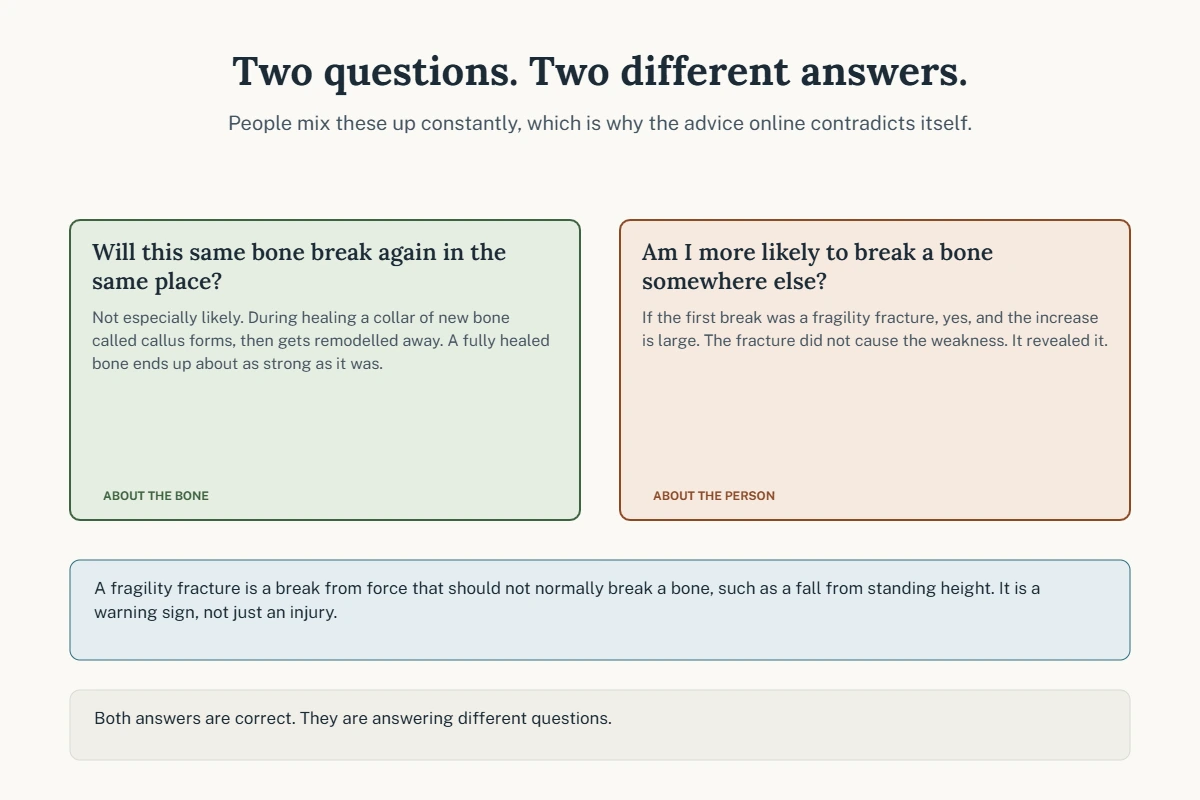
Both are correct. They are answering different questions.
| The question | The answer |
|---|---|
| Will this same bone break again in the same place? | Not especially likely. Healed bone is roughly as strong as it was. |
| Am I more likely to break a bone somewhere else? | If the first break was a fragility fracture, yes, and the increase is large. |
The first question is about the bone. The second is about the person. Once you separate them, the confusion disappears.
Question One: The Same Bone
You have probably heard that a broken bone heals back stronger. It is half true, and the half that is wrong matters.
While a fracture heals, your body forms a collar of new bone around the break called callus. For a while, that site really is thicker and bulkier than the bone around it.
Then the remodeling process goes to work. Over months, the extra material gets trimmed away and the bone returns to something close to its original shape and strength.
A fully healed bone is about as strong as it was before. Not weaker, not permanently stronger. If you apply the same force to it again, you will get much the same result.
There are exceptions. A fracture that did not heal properly, or healed out of position, can leave a weaker spot. Hardware such as plates and screws changes how force travels through the bone. Those are specific situations for your surgeon, not general rules.
Question Two: The Fragility Fracture
This is the important one, and it is well established in medicine.
A break caused by force that should not normally break a bone. The usual example is falling from standing height. It tells you the bone itself is weak.
If someone falls from a ladder and breaks their wrist, that is force doing what force does. If someone trips on a rug and breaks their wrist, that is different. The fall was minor. The bone gave way anyway.
That second event is a warning. It usually means bone density has dropped, often because of osteoporosis, and it means the next fall is likely to do damage too.
The risk is front loaded
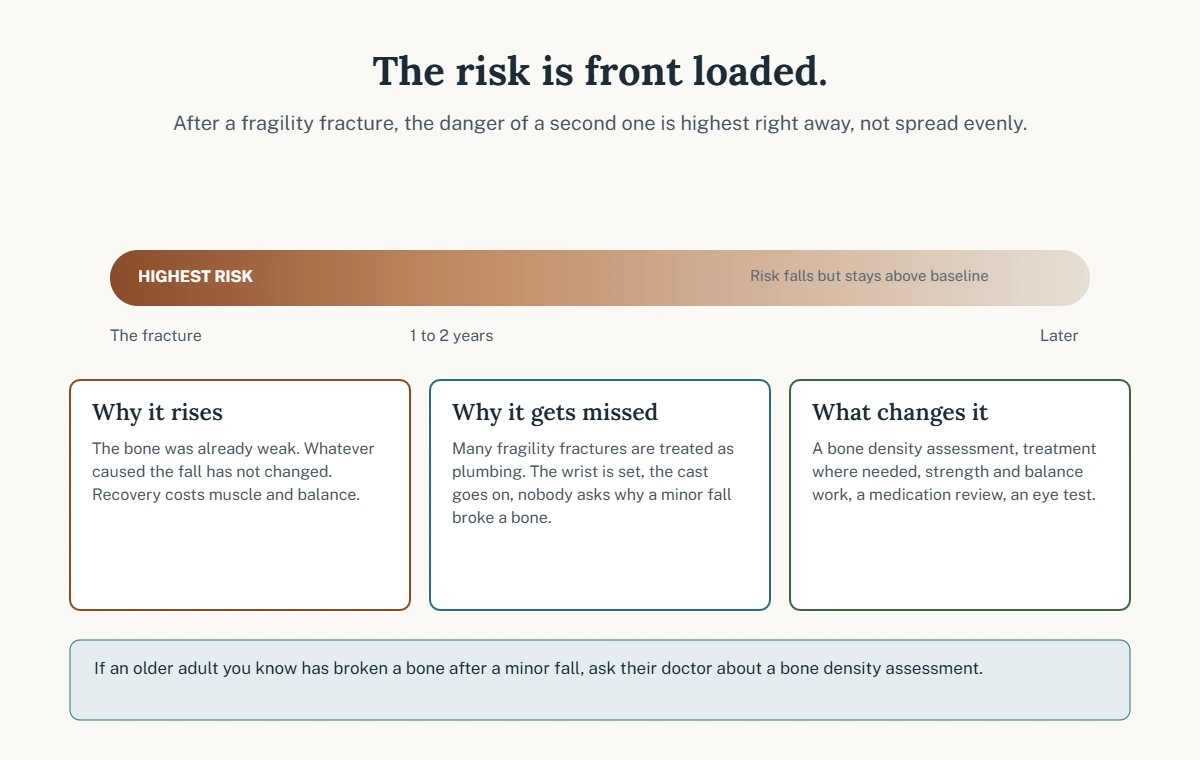
Clinicians sometimes talk about imminent fracture risk. The danger of a second fracture does not spread evenly across the following decade. It is highest in the first year or two after the first one.
The National Institute of Arthritis and Musculoskeletal and Skin Diseases makes this point directly. For older adults, the period right after a first break is when the risk of another fracture is greatest, and it is the window in which action helps most.
Why this gets missed
A great many fragility fractures get treated as plumbing problems. The wrist is set, the cast goes on, the patient goes home. Nobody asks why a minor fall broke a bone in the first place.
That missed question is the reason specialist services exist to catch these patients and assess them for osteoporosis. If you or a parent has broken a bone from a small fall, it is reasonable to ask a doctor directly whether a bone density scan is appropriate.
If an older adult in your life has broken a bone after a minor fall, ask their doctor about a bone density assessment. This is one of the few places where a simple question genuinely changes outcomes. This page is general information, not medical advice about a specific person.
Why the Risk of Another Fracture Rises
Several things stack up at once.
- The bone was already weak. The first fracture did not cause the weakness. It revealed it, and the weakness is still there afterwards.
- Falls repeat. Whatever caused the first fall, whether balance, eyesight, medication or hazards at home, usually has not changed.
- Recovery costs strength. Time in a cast or in bed reduces muscle and balance, which makes the next fall more likely.
- Fear changes movement. People move more cautiously after a fracture, and reduced activity weakens bone and muscle further.
In younger people, a different version of this exists. Someone who breaks bones through skateboarding will probably keep skateboarding. The repeat risk there is about behaviour, not bone.
About the Name
Clinicians have used phrasing like “fracture begets fracture” for a long time to describe this pattern. It predates the social media trend by decades.
That is worth knowing, because the phrase “broken bone theory” now points at five different ideas. This clinical pattern is one of them, and it is the only one with solid research behind it.
The viral version claims something else entirely. It says people who never fracture carry emotional pain instead. Those two ideas share a few words and nothing more. We cover the full split on the main broken bone theory guide.
What Actually Reduces the Risk
If a fragility fracture has happened, these are the things that change the odds.
- A bone density assessment, so treatment decisions rest on data
- Treatment for osteoporosis where it is diagnosed
- Enough calcium and vitamin D
- Strength and balance work, which lowers fall risk and supports bone
- A medication review, since some drugs raise fall risk
- Practical changes at home such as lighting, rugs and grab rails
- An eye test, which is easy to forget and genuinely matters
Questions People Ask
Does breaking a bone make you more likely to break another?
It depends which question you mean. Re-breaking the same healed bone is not especially likely. But if the first break was a fragility fracture, usually an older adult falling from standing height, the risk of a different fracture rises sharply.
Do broken bones heal back stronger?
Not permanently. Extra bone called callus forms during healing, so the site is thicker for a while. That gets remodeled away, and the finished bone ends up about as strong as it was before.
What is a fragility fracture?
A break from force that should not normally break a bone, such as a fall from standing height. It signals that the bone is weak and is treated as a warning sign for osteoporosis.
When is the risk of a second fracture highest?
For older adults, in the first year or two after the first fracture. Clinicians call this imminent fracture risk, and it is why prompt assessment matters.
Is this the same as the broken bone theory on TikTok?
No. This is a documented clinical pattern about fracture risk. The viral theory is folklore claiming people who never fracture carry emotional pain instead. They share a phrase and nothing else.
Sources and Further Reading
- National Institute of Arthritis and Musculoskeletal and Skin Diseases (NIAMS). Preventing another broken bone. niams.nih.gov
- NIAMS. Osteoporosis overview. niams.nih.gov
- Hackensack Meridian Health. Do broken bones heal stronger? hackensackmeridianhealth.org
- CreakyJoints. Secondary fractures: what they are and how to prevent them. creakyjoints.org
Sources last checked September 27, 2026.