Fear of Breaking Bones: Why It Happens and What Helps
Evidence
A fear of breaking bones is more common than most people realise. Here is where it comes from, when it stops being useful, and what actually helps.

Key points
- Some caution about injury is normal and useful. It only becomes a problem when it shrinks your life.
- Fear of breaking a bone usually sits inside a bigger picture: a specific phobia, health anxiety, or fear after an injury.
- Fear of falling in older adults is well studied, and avoiding movement because of it actually raises fall risk.
- This fear responds well to treatment. Graded exposure with a therapist works for most people.
- If the fear is stopping you doing ordinary things, that is the sign to get help.
Call or text 988 in the United States for the Suicide and Crisis Lifeline. Text HOME to 741741. Outside the United States, our resources page lists services by country.
What This Fear Looks Like
People describe it in different ways. Some flinch at the thought of a bone snapping. Some cannot watch an injury in a film. Others avoid ladders, ice, sport, or stairs long after any real danger has passed.
A few common patterns show up in clinic:
- Checking the ground constantly when walking
- Turning down activities most people would do without thinking
- Feeling sick or faint at the idea of a fracture or an X-ray
- Reading about bone health late at night and feeling worse afterwards
- Gripping handrails hard, or refusing to go out when it rains
None of these on their own means something is wrong. Together, and if they are shrinking your week, they are worth attention.
Does It Have a Name?
There is no official diagnosis called “fear of broken bones”. You may see the word osteophobia online, but doctors do not use it and it does not appear in the diagnostic manuals.
What we do recognise is the category it usually falls into.
An intense fear of one particular thing or situation, out of proportion to the actual danger, that a person goes out of their way to avoid. Fear of injury sits in this group.
One subtype matters here. Blood, injection and injury phobia behaves differently from every other phobia. Most fears raise your heart rate. This one often drops it, which is why people faint at the sight of blood or a broken limb. That is a physical reflex, not weakness, and it has its own specific treatment.
Who Tends to Get It
People who have already broken something
Fear after an injury is normal and usually fades. When it does not, physiotherapists call it kinesiophobia, which means fear of movement. People avoid loading the limb because they expect pain or re-injury, the muscle weakens from disuse, and recovery stalls. The fear then looks justified, which makes it stronger.
Older adults
Fear of falling is one of the better studied versions of this. It is common after a fall, and it carries a cruel twist. People move less to stay safe, and less movement means weaker muscles and worse balance, which raises the risk of the fall they were trying to avoid.
This matters most after a fragility fracture, when the real medical risk is already higher.
People with osteoporosis, or a family history of it
Here the fear has a basis in fact, which makes it harder to untangle. The task is not to talk someone out of a real risk. It is to get the risk properly assessed and treated, so the worry has somewhere to go.
Parents
Watching a child climb is uncomfortable for most parents. It becomes a problem when it stops the child doing ordinary things, because active play is how children build the bone and coordination that protect them later.
Normal Caution or Something More?
The useful question is not how frightened you feel. It is what the fear is costing you.
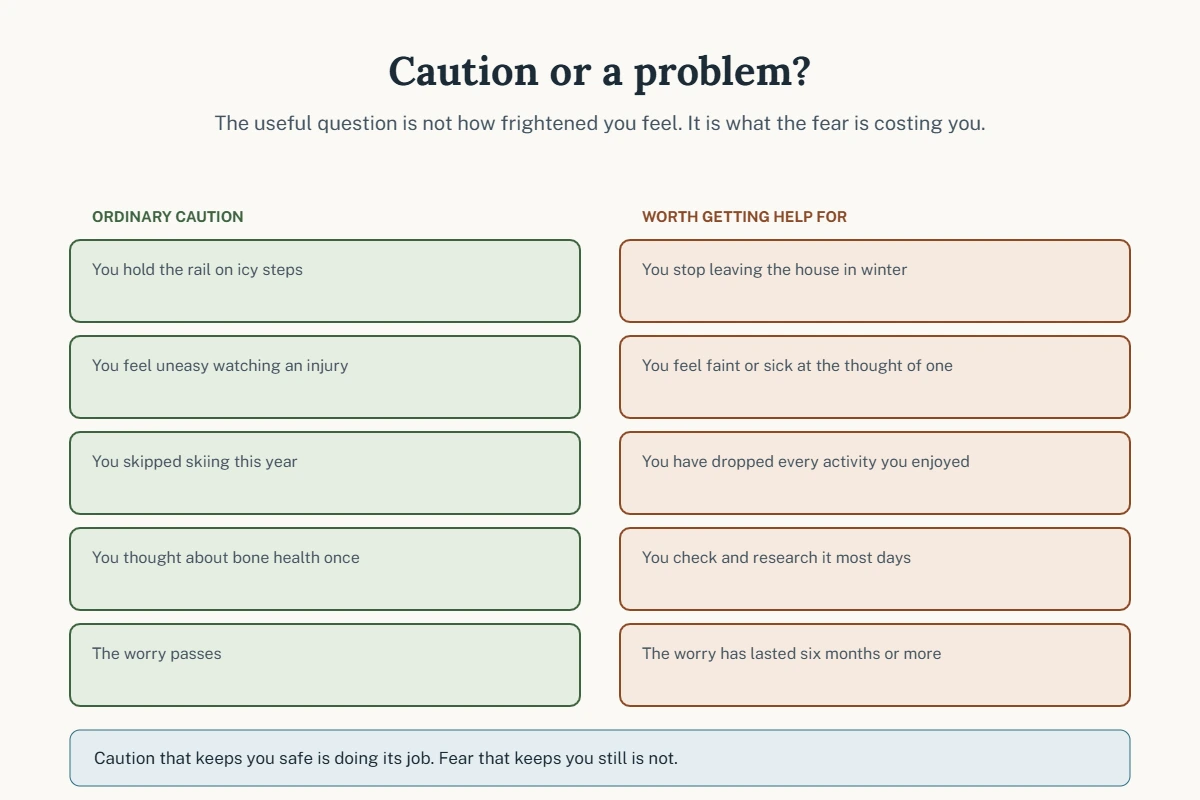
| Ordinary caution | Worth getting help for |
|---|---|
| You hold the rail on icy steps | You stop leaving the house in winter |
| You feel uneasy watching an injury | You feel faint or sick at the thought of one |
| You skipped skiing this year | You have dropped every physical activity you used to enjoy |
| You thought about bone health once | You check and research it most days |
| The worry passes | The worry has lasted six months or more |
Is the fear protecting you, or is it running your week? Caution that keeps you safe is doing its job. Fear that keeps you still is not.
Why the Fear of Breaking Bones Happens
Usually some mix of these, rather than one cause.
- Direct experience. A bad fracture, a long recovery, or a frightening hospital visit.
- Watching it happen. Seeing someone else break a bone, especially as a child.
- Learning it at home. Children of very anxious parents often inherit the alarm rather than the danger.
- A general anxious tendency. Where this fear is one of several worries rather than the only one.
- The fainting reflex. For the blood and injury type, the body reacts before the thought arrives.
The Link to the Broken Bone Theory
This page sits on a site about the broken bone theory, and the two connect in a way worth naming.
The theory claims that people who have never broken a bone carry hidden emotional pain instead, as some kind of trade. There is no evidence for that, and we go through why on is the broken bone theory real.
But a plainer version of the pattern does exist, and it runs the opposite way. Some people reach adulthood without a fracture partly because they are cautious, and that same caution can come with anxiety. One underlying trait, two results. No trade, no cosmic arrangement, nothing chosen for you.
If you came to this site because the theory felt true, this may be closer to what you actually recognised.
What Actually Helps
Graded exposure
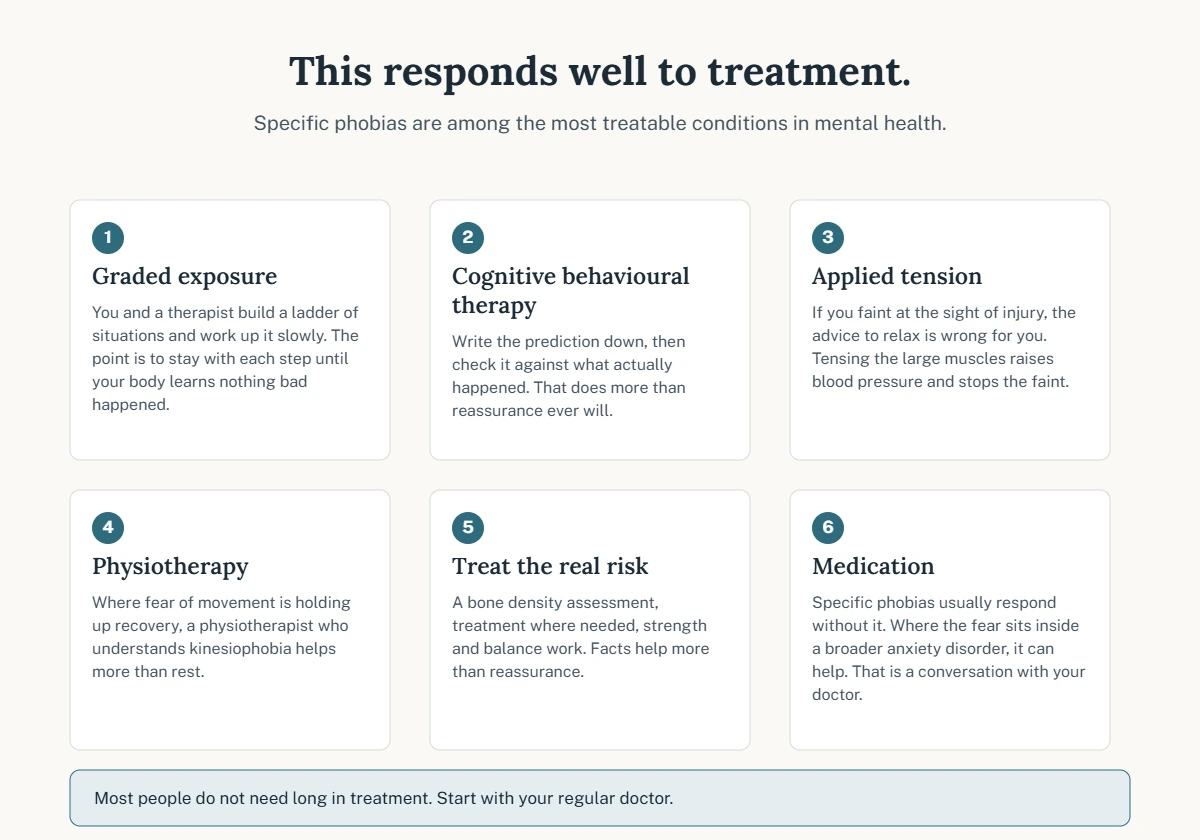
This is the main treatment and it works well. You and a therapist build a ladder of situations, from mildly uncomfortable to very difficult, and work up it slowly. The point is not to force yourself through panic. It is to stay with each step long enough for your body to learn that nothing bad happened.
Cognitive behavioural therapy
Alongside exposure, CBT looks at the predictions driving the fear. Most people are not estimating risk accurately. Writing the prediction down and then checking it against what actually happens does more than reassurance ever will.
Applied tension, for the fainting type
If you faint at the sight of blood or injury, the usual advice to relax is wrong for you. Applied tension teaches you to tense the large muscles in your arms and legs to raise blood pressure and stop the faint. It is simple, it is specific to this subtype, and it is taught in a few sessions.
Physiotherapy, after an injury
Where fear of movement is holding up recovery, a physiotherapist who understands kinesiophobia will usually do more good than rest will.
Treating the real risk
If you are genuinely at higher risk, get it measured. A bone density assessment, treatment where it is needed, and strength and balance work all reduce both the risk and the worry. Facts help more than reassurance.
Medication
Specific phobias usually respond to therapy without medication. Where this fear sits inside a broader anxiety disorder, medication can help, and that is a conversation with your own doctor rather than something to decide from an article.
When to See Someone
Consider talking to a professional if any of these fit:
- The fear has lasted six months or more
- You are avoiding things you want to do
- You feel faint or sick at the thought of injury
- Recovery from an injury has stalled and the limb feels fine but you cannot use it
- You are checking, researching or seeking reassurance most days
- Someone close to you has noticed your world getting smaller
Start with your regular doctor. This is one of the more treatable things in psychiatry, and most people do not need long in treatment.
Questions People Ask
Is there a phobia of breaking bones?
There is no separate official diagnosis for it. Doctors would usually call it a specific phobia of injury. The word osteophobia appears online but is not used in medicine.
Why do I feel faint thinking about a broken bone?
That points to the blood, injection and injury subtype, which lowers heart rate and blood pressure instead of raising them. It is a reflex rather than a choice, and a technique called applied tension treats it specifically.
Is being scared of falling normal as you get older?
It is very common, particularly after a fall. It needs attention because moving less to stay safe weakens muscle and balance, which raises fall risk rather than lowering it.
What is kinesiophobia?
Fear of movement, usually after an injury. People avoid using the limb because they expect pain or re-injury. It is a recognised obstacle in rehabilitation and physiotherapists treat it directly.
Can fear of breaking a bone be cured?
Specific phobias are among the most treatable conditions in mental health. Graded exposure with a therapist helps most people, often in a small number of sessions.
Does avoiding exercise protect my bones?
No, it does the opposite over time. Weight bearing exercise builds and maintains bone, and strength and balance work lowers fall risk. Avoiding movement weakens both.
Sources and Further Reading
- National Institute of Mental Health. Specific phobia. nimh.nih.gov
- National Institute of Arthritis and Musculoskeletal and Skin Diseases. Bone health and osteoporosis. niams.nih.gov
- NIAMS. Preventing another broken bone. niams.nih.gov
- Centers for Disease Control and Prevention. Older adult fall prevention. cdc.gov
Sources last checked 3 October 2026. This page is general information, not a diagnosis. See our medical disclaimer.